
Half a decade after the closing of Vigil Games and parent company THQ, the Darksiders series finally has a new home with THQ Nordic and studio Gunfire Games. The long-awaited return of the franchise brings back the lore and universe that fans remember, as well as a host of new issues as a result of a smaller studio and reduced development costs.
After experiencing the Apocalypse from the perspective of horsemen War and Death, Darksiders 3 tells the story of sister Fury hunting down the seven deadly sins for the Charred Council, an ancient entity in charge of balance in the universe. Along the way, the game falls victim to all of these sins. I will highlight how each sin was committed and how it kept a decent game from reaching its potential.
Pride
It is said that pride is the first and last of the seven deadly sins and thus it makes sense that this sin is the reason for all the game’s other issues. The game is guilty of pride due to the fact that they released Darksiders 3 as a finished game. This game is a paid beta if I’m being generous, and a paid alpha if I’m being honest. There are issues with rendering audio, loading textures, and game breaking crashes and bugs that are not common in even the smallest indie titles. In short it’s unfinished, and that fact bleeds through every other fabric of the story, gameplay, and world.
Greed
There’s an overwhelming sense that the team at Gunfire Game bit off more than they could chew. The scope of the game far exceeds what the new studio was capable of which left the majority of the boss fights and enemy encounters feeling uninteresting and anemic. There is a lot of enemy types, but none of them are that different.
Sloth
While on the topic of enemies, there are a number of issues with how defensive enemies function. Being confronted by an enemy with a shield oftentimes means doing the same thing over and over while waiting for their oversized life bar to slowly drain.
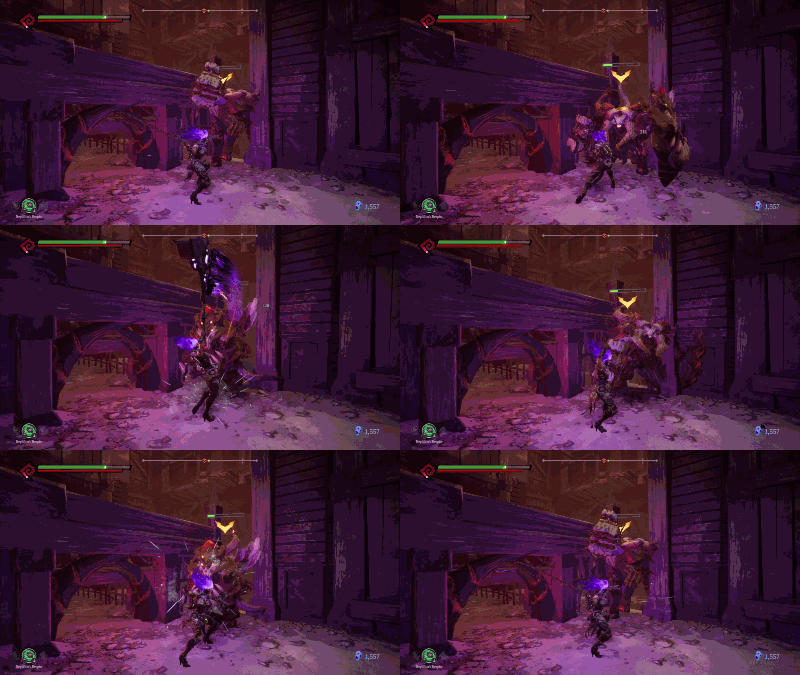
There are also a number of unnecessarily slow moments in the gameplay from poor checkpoint placements to confusing auto-death elements (I’m looking at you, tornado segments). The puzzles do no favors when it comes to pacing either, though to their credit they add some much needed variety.
Envy
Darksiders 3 doesn’t know when to stop looking at the other guy, and for this project, the “other guy” was undoubtedly Dark Souls. While the formula they borrowed is fun and interesting enough to compel you forward, the game makes no effort to differentiate itself despite being an inherently different game. For example, where Dark Souls does an excellent job of making you feel like a weak entity overcoming incredible odds, Darksiders 3 tries to convince you that Fury is an incredibly powerful being breezing through the world while constantly counteracting that claim throughout the gameplay. Weapons are upgraded the same way as Dark Souls as well but due to other gameplay differences I was only able to get one of my weapons higher than level 2 (out of 10). Similarly the game world includes a huge number of consumable XP items despite the leveling system not justifying it, which leads me to…
Gluttony
It’s rare that I play a game where there are actually too many items to collect but that is definitely the case here. While all pickups in this game have the same visual look as pickups in Dark Souls, they almost never carry the same weight. Near the end of the game I used (seriously) hundreds of XP consumables to level up over 15 times which felt more like the developer misunderstanding how XP pickups work than a satisfying gameplay experience. There were other consumable pickups that were meant to bolster your “wrath” or “havoc” meters though I can safely say I never felt compelled to use any of them in a meaningful way.
Wrath
Fury, as a character, feels one dimensional even when undergoing her growth arc. To be fair, I can’t imagine it’s an easy task to write a character named “Fury” as anything but angry. That being said, there were small moments where I cared about Fury’s growth before being numbed again by the cringey and atonal discourse between her and her companion, the Watcher. All in all, the writing struggled to find its footing throughout the whole story. There are other needlessly frustrating elements such as difficult enemy groupings with no sense of intentional design and an unreliable dodge roll.
Lust
There is a moment in the game where the character Lust tempts Fury with everything she dreams of, including the story finally reconnecting with the other horsemen. This ends up being a great metaphor of the shortcomings that the story actually holds. I was very interested in a number of the plot lines as they developed, but all of them somehow found a way to be disappointing or fall flat. The game even includes a secret ending that doesn’t change a single plot point and leaves the question of why it’s there at all.
The Virtues
While there are a lot of issues, Darksiders 3 also has a number of remarkable elements. Each of the bosses are distinct and memorable in terms of their writing and visual design. The world has a wonderful sense of presence and traversal via switching between “Hollows” is a joy. The combat feels great when it works and the trinkets give a great reason to use all the weapons in your repertoire. The physics based puzzles were generally satisfying as well.
Darksiders 3 feels like an incredible game that is buried by technical problems and questionable design choices. There were moments where I couldn’t wait to see what’s next, though I can’t think of a single time those moments paid off. The combat stands out as a strength despite being marred by questionable enemy design and poor frame rate. As a whole, it’s an enjoyable and deeply flawed experience that borrows too heavily from its influences to form an identity of its own.
Final Score: 6.5/10
-NSL
 Nathan S. Lewis